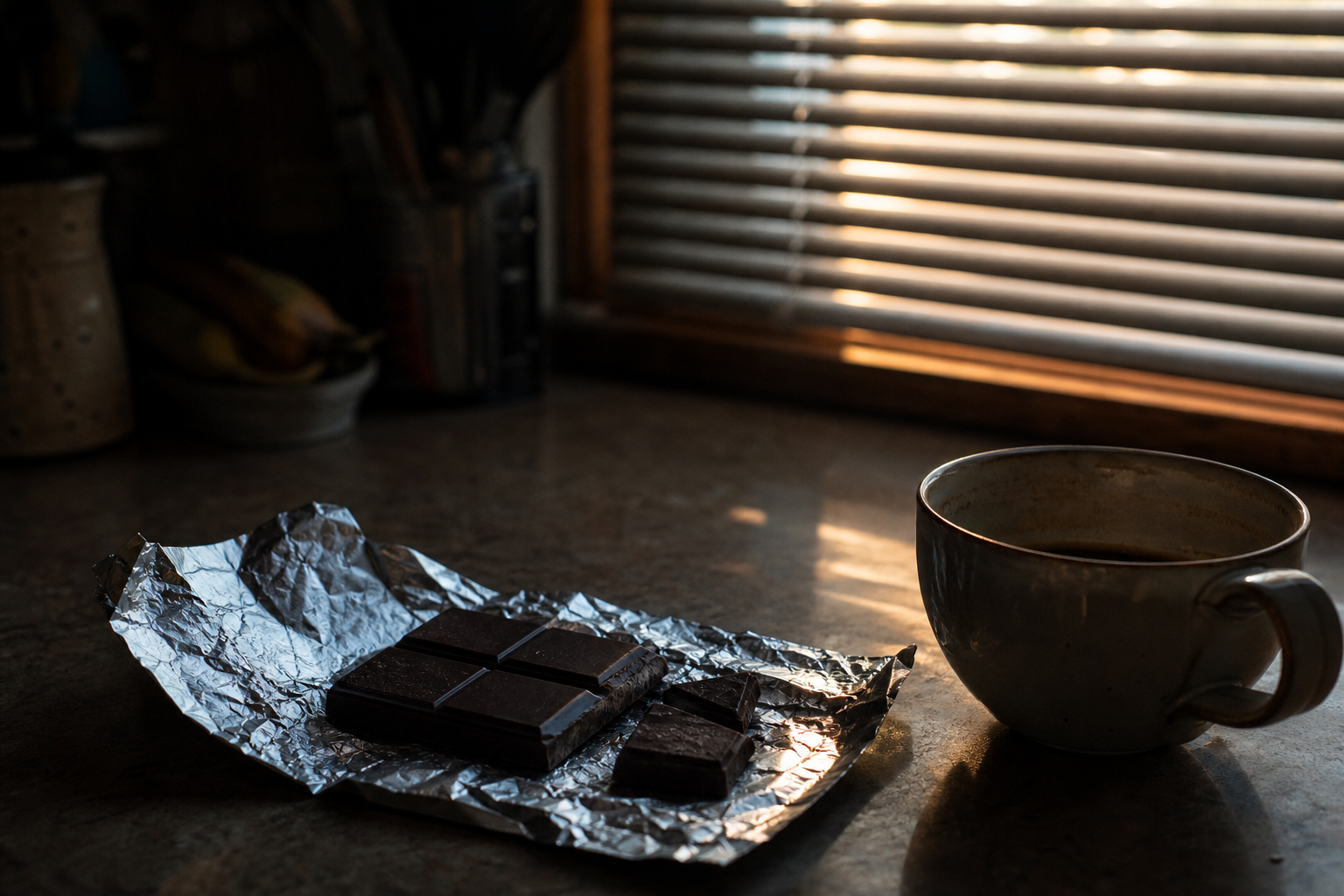
The chocolate didn't cause the migraine: the migraine caused the chocolate.
Craving chocolate, carbs, or a third coffee hours before the pain starts is a documented premonitory symptom. Logs that begin at headache onset record it as the cause.
Three years without red wine, same number of attacks
Three years off red wine. Aged cheese gone, chocolate gone, anything cured crossed off at the grocery store.
And the attacks kept exactly the schedule they'd always kept.
You've either lived that or read it a hundred times. The elimination list grows, the diet shrinks, frequency doesn't move, and the conclusion is always that one more trigger is still hiding somewhere in the pantry. There's a less exhausting explanation, and it has decent evidence behind it. For a lot of people the food never triggered anything. The attack had already started, quietly, hours earlier. The craving was one of its first symptoms. The snack got blamed because it was the last thing that happened before the pain.
The last-thing-you-ate error
Migraine doesn't begin at the headache. The premonitory phase runs anywhere from an hour to two days ahead of pain, and it's generated upstream: hypothalamic activity shifts before a single throb registers (Maniyar et al., Brain 2014; Schulte and May, Brain 2016). The hypothalamus also runs appetite. So the same early machinery that produces yawning, neck stiffness, thirst, mood change and light sensitivity produces the urge for chocolate, bread, or a third coffee.
Call it the last-thing-you-ate error. A symptom that arrives early gets written down as a cause, because it's the one prodrome event that leaves physical evidence. Nobody logs "yawned eleven times at 2pm." Everybody remembers the chocolate. The wrapper is in the bin, the timestamp is in your memory, and the story writes itself in the wrong order.
Why the standard trigger list can't catch this
Trigger-avoidance is the most repeated guidance in migraine care, and the top search results for any food question converge on the same shape: here's the list, keep a diary, eliminate and reintroduce. On the categories with real evidence behind them, that advice is fine. Stress, disrupted sleep, skipped meals, hormonal change. Those hold up across large patient surveys.
The failure here is structural, not clinical. A food diary that asks what you ate and whether you got a headache can only produce correlations running in one direction. There's no column for "wanted it unusually badly," no timestamp for the fog that started at 1pm, and no way to represent that appetite change is itself on the standard premonitory symptom list. Feed backwards-sequenced data into an elimination protocol and you get an elimination protocol that removes innocent foods for years while the real pattern stays invisible.
What the provocation studies actually found
Chocolate is the one that's been tested blind, more than once. Moffett, Swash and Scott ran a double-blind chocolate-versus-placebo trial in 1974 (J Neurol Neurosurg Psychiatry) and found no significant excess of attacks from chocolate. Marcus and colleagues repeated the design against a carob placebo in 1997 (Cephalalgia) and landed in the same place. One smaller 1991 study, Gibb et al. in Cephalalgia, reported the opposite, so the literature isn't unanimous Moffett et al. 1974's double-blind study included 25 patients with migraine. ([source](https://www.mattioli1885journals.com/index.php/actabiomedica/article/download/3449/3075)).
The diary evidence arrives at the same conclusion from a different direction. In Giffin's electronic-diary study, patients who logged premonitory symptoms predicted their own headaches from those symptoms alone in 72% of attacks, and food craving sits on the premonitory list beside yawning, fatigue and neck stiffness. Karsan and colleagues put the whole question in a paper title: are some patient-perceived migraine triggers simply early manifestations of the attack? Karsan et al., 'Are some patient-perceived migraine triggers simply early manifestations of the attack?' J Neurol. 2021 May;268(5):1885-1893. ([source](https://pubmed.ncbi.nlm.nih.gov/33399964/))
72%
of attacks correctly predicted by patients from premonitory symptoms alone, hours before any painGiffin et al., Neurology 2003
27%
of migraine patients named food as a trigger, a small fraction compared to the large majority who named stressKelman, Cephalalgia 2007
Commonly blamed
What controlled or diary evidence shows
Better read as
Chocolate
Double-blind provocation against placebo found no excess of attacks (Moffett 1974; Marcus 1997). One smaller study reported the opposite (Gibb 1991).
Prodrome craving in most cases
Carbohydrate or sugar bingeing
Appetite change and food craving appear on the standard premonitory symptom list in diary studies (Giffin 2003).
Prodrome craving
Skipped meals or fasting
Strongly and consistently self-reported as a trigger, but loss of appetite can also show up as an early warning sign on its own, which makes the two hard to pull apart from self-report alone.
Ambiguous, log both directions
Red wine and alcohol
Provocation evidence is stronger here than for chocolate Littlewood's 1988 study found red wine provoked migraine in 9 of 11 patients, versus none of 8 given vodka ([source](https://www.sciencedirect.com/science/article/pii/S0140673688913530)).
Plausible true trigger in a subset
Bright light, strong odors
Photophobia and osmophobia are documented during the premonitory phase, before pain onset (Schulte, Jürgens and May 2015).
Early attack symptom
Stress, sleep disruption, hormonal change
The most consistent trigger findings across large patient surveys (Kelman 2007).
True triggers
Where each commonly blamed trigger sits once provocation studies are separated from self-report. A meta-analysis of 11 clinic-based studies found the most common migraine prodromal symptoms were fatigue (49%) and neck stiffness (46%) ([source](https://www.neurology.org/doi/10.1212/CPJ.0000000000200359))
Seventeen hours, logged two ways
Tuesday, 2pm. Slightly foggy, reading the same email twice, yawning more than usual. Nobody counts yawns.
5pm: a hard craving for something sweet. Two rows of dark chocolate, eaten standing at the counter.
11pm: neck feels tight. Sleep comes late.
Wednesday, 7am: pain behind the right eye, photophobia, nausea.
Logged the usual way, that's a single entry. Wednesday, migraine, suspected trigger: chocolate. Logged from the prodrome forward, it's a seventeen-hour arc in which the craving is the third symptom to appear, and chocolate never picks up a criminal record.
Run that comparison across ten attacks and the pattern becomes legible. If the craving shows up ahead of the pain nearly every time, the food is a passenger. If attacks follow the food when there was no craving in front of it, inside a consistent window, you've got a real candidate worth avoiding.
What changes if the sequence runs backwards
Two things change. Your list of forbidden foods probably shrinks, which matters more than it sounds. Restrictive eating carries its own cost, and dinner with friends shouldn't require a risk assessment.
The bigger one is that your prodrome becomes useful. That craving you'd been treating as a lapse in discipline is a multi-hour warning, and warnings can be acted on. Acute treatment lands better the earlier it goes in Ubrogepant given during the migraine prodromal phase may improve prodromal symptoms, with effects possibly seen as early as 1 hour post-dose. ([source](https://www.nature.com/articles/s41591-025-03679-7)). Water, a dark room, a moved meeting and an earlier bedtime all cost less at 5pm on Tuesday than at 7am on Wednesday. The food question is small. The eighteen hours you've been throwing away because nothing was recording them are not.
This is not a green light on every food
The blinded evidence against chocolate as a standalone trigger is reasonable. The evidence for stress, disrupted sleep, fasting and hormonal change is strong and isn't in question here. If a specific food reliably produces an attack inside a consistent window, with no craving beforehand, keep avoiding it. The argument in this piece is narrow: it's about the foods you wanted badly right before the pain arrived.
The log has to start earlier than the pain
Which brings up the tracking problem. Most migraine logs open their entry form at pain onset: when did it start, how severe, what did you take, what triggered it. The trigger field is a free-text box filled in retrospectively, after the attack, by someone reconstructing yesterday through brain fog. That design can't settle this question, because everything you'd need to capture happened before the entry begins.
We built Postdrome to run a continuous timeline rather than an attack record. Prodrome symptoms get their own timestamps, cravings included, and the entry stays open through the after-phase instead of closing when the pain stops. Aura Mode exists because logging a 5pm symptom with visual disturbance shouldn't mean squinting at small grey text. One purchase, no subscription, and the data stays on your device, which is the only arrangement we'd accept for a file that contains this much of your medical life.
If you want to find out whether the craving comes before the pain, you need the hours before the pain on record. Postdrome logs the prodrome, the attack, and the after-phase as one continuous timeline. One purchase, no subscription, your data stays on your device.
Postdrome was built because every tracker we tried stopped at the headache. The prodrome, where the craving lives, and the 24 to 72 hours afterward, where the fatigue and fog live, were either missing or squeezed into a notes field. A timeline that starts at the first premonitory symptom and runs through the after-phase is the only shape that can answer the chocolate question, and it's the shape that gives a neurologist something more useful than a count of bad days.