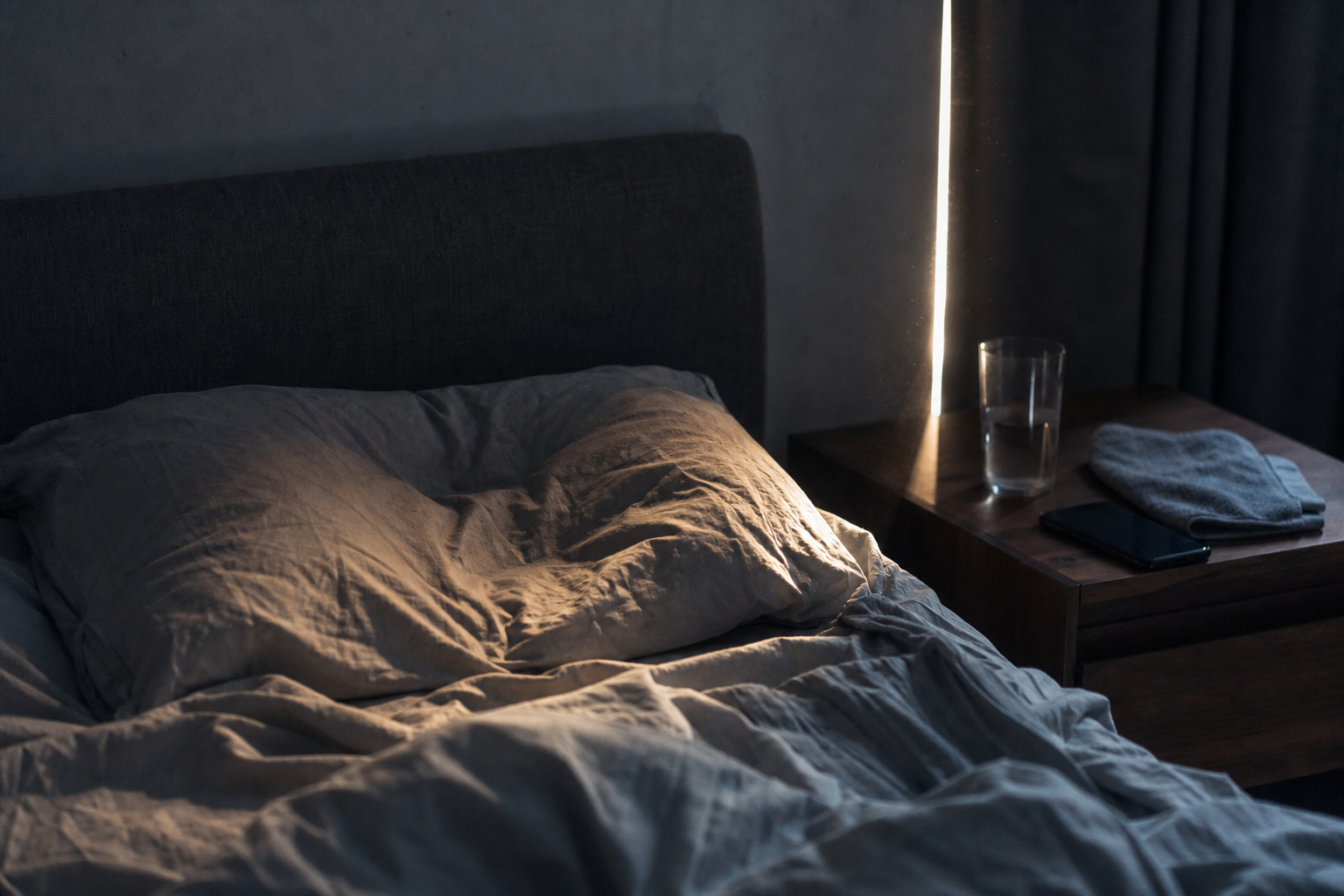
The sleep after a migraine is still part of the migraine.
Why you sleep so much after a migraine, why most trackers never see that sleep, and how logging it turns a lost day into a pattern you can read.
Waking up at 7 a.m. with yesterday gone
The attack finally broke around 4 in the afternoon. You'd taken the last dose you were allowed, pulled the blinds, and gone under. Now it's 7 the next morning.
Fifteen hours. The pain is gone. You are not back.
Your neck is stiff, the kitchen light is too much, and your first clear thought is arithmetic: a whole day spent unconscious, and the sleep didn't fix it. Most people file this under recovery. Rest, like after a fever. The migraine ended, the body caught up, done.
Open your tracker and the record agrees with them. Attack started, attack peaked, attack ended at 4 p.m. The fifteen hours you just lost don't appear anywhere.
The unlogged night
That sleep belongs to the attack. It's the first stretch of the postdrome, and it has properties you can measure: when it started relative to the pain resolving, how long it ran, and what you woke up still carrying.
Call it the unlogged night, because in most migraine records it's the one span with no entries at all. You're asleep, so you can't rate anything. The app has already closed the attack. And by the time you're upright again, the only thing you want to record is that it's over.
But treat the sleep as a data point and it starts answering questions a pain log can't. Does the long sleep follow every attack, or only the ones you treated late? Is it getting longer over the year? Does waking with a stiff neck predict a rough second day? None of that is visible one attack at a time. Across ten attacks, all of it is.
Why 'recovery sleep' is the wrong label
Most migraine trackers are built around pain. Start time, peak intensity, medication, end time. The attack is defined as the span between first pain and last pain, so the moment the headache resolves, the record closes.
That design choice has a quiet consequence. Everything after pain resolution gets treated as the aftermath of a finished event, and sleep is the easiest thing to wave through because sleep sounds healthy. It sounds like the cure.
The word recovery also implies you come out of it restored. Plenty of people don't. They wake unrefreshed, still light-sensitive, still slow (the waking fog and fatigue get their own treatment in our piece on why those two aren't the same symptom). A recovery that hands you back the same symptoms isn't recovery. It's the next phase of the attack, running while you're in no position to notice it.
What the research actually documents
The postdrome is well documented. In a 2016 electronic diary study in Neurology, Giffin and colleagues followed attacks as they happened and found that most patients reported at least one non-headache symptom after the pain resolved, with feeling tired or weary the most common. The International Classification of Headache Disorders (ICHD-3) describes postdromal symptoms, most often tiredness, difficulty concentrating and neck stiffness, as able to persist for up to 48 hours after the headache resolves. The American Migraine Foundation's overview of attack phases also places fatigue in the postdrome AMF's page 'The Timeline of a Migraine Attack' is at americanmigrainefoundation.org/resource-library/timeline-migraine-attack/ ([source](https://americanmigrainefoundation.org/resource-library/timeline-migraine-attack/)).
So the tiredness is on the record. What the literature can't give you is a normal duration for your own post-attack sleep, or a way to see whether yours is changing. Group studies describe the phase. Only your records describe your version of it.
There's a confounder, too. Some acute migraine medications, including several triptans, list drowsiness among their side effects, and some antiemetics used during attacks are sedating. Log the sleep without logging what you took beforehand and you can't separate the postdrome from the medicine cabinet.
81%
of patients in a prospective e-diary study reported at least one non-headache postdrome symptomGiffin et al., Neurology 2016
48 hours
how long ICHD-3 says postdromal symptoms may persist after the headache resolvesICHD-3, International Headache Society 2018
What it looks like across a few logged attacks
An illustrative case, not a study. Someone logs three attacks over two months, sleep included.
The first one they treat within the hour. Pain clears by early evening, they sleep a normal night, and they wake with mild neck stiffness that's gone by lunch. The second they treat late, after a meeting they couldn't leave. Pain clears midafternoon, they're down until the next morning, and they wake light-sensitive and slow. The third goes the same way as the second: late dose, long sleep, heavy morning.
In a pain-only log, those are three attacks of similar length. In a log that keeps the attack open, two of them run nearly a full day longer, and the long ones share a trigger for the long sleep that has nothing to do with pain intensity.
Three attacks don't prove anything. They do give this person a precise question for their neurologist: does late treatment stretch my postdrome, and is that worth changing how I dose? That question simply doesn't exist without the sleep entries.
What changes when the sleep counts
The honest answer to 'how long do your attacks last' changes. If you routinely lose the evening and the night after the pain stops, your attacks are longer than your log says, and so is the time migraine takes from work, family and plans. That matters in an appointment. It matters more when you're documenting missed days for an employer or an insurer.
The medication picture sharpens, because you can finally tell a drowsy dose from a long postdrome. And the end of the attack moves to where it belongs: the point you felt like yourself again.
None of this needs entries while you're asleep. Two notes do it, one as you go down and one when you come back up. So log the sleep.
What to log
Why it matters
When you went down, relative to pain resolving
Separates sleeping an attack off from sleeping after it ended
When you woke
Gives the sleep a duration you can compare across attacks
What you took before sleeping
Separates medication drowsiness from postdrome sleep
How you woke: refreshed, unrefreshed, or still symptomatic
The difference between rest and a phase still running
Symptoms on waking (light sensitivity, neck stiffness, fog, mood)
Shows what the sleep cleared and what it didn't
When you felt like yourself again
The real end of the attack
A post-attack sleep log. Every field gets filled in on either side of the sleep, never during it.
When long sleep is a reason to call a clinician
If someone can't be woken normally, or post-attack sleep is new or suddenly much longer than your usual pattern, or it comes with confusion, weakness, trouble speaking, or a headache unlike your usual attacks, that's a call to a clinician or emergency services, not a log entry.
Where Postdrome fits
Postdrome was built around one decision: the attack stays open until you close it, not when the pain stops. The timeline keeps running through the after-phase, so the note you make before going down and the one you make on waking land in the same attack instead of drifting off as separate entries.
Aura Mode is built for the entries you make while light still hurts. Your records stay on your device, and you can export them when a neurologist or an insurer asks what your attacks actually cost you. One lifetime price, no subscription.
Ten attacks from now, you'll know how long your postdrome sleep runs, what stretches it, and what it leaves behind. No group study can tell you that.
Log the whole attack, sleep included. Get Postdrome.
Postdrome keeps each attack open past the moment the pain stops, so the sleep, the stiff neck on waking, and the slow second day land in the same record as the headache. Entries work in Aura Mode when light still hurts, records stay on your device, exports are there when a neurologist or insurer asks, and it's one lifetime price with no subscription.