The five migraine trackers worth keeping, and the five to drop.
The fix for tracking burnout is not a better app with more fields. It is logging less, and logging the things your neurologist can actually act on.
Fifty questions, one working brain cell
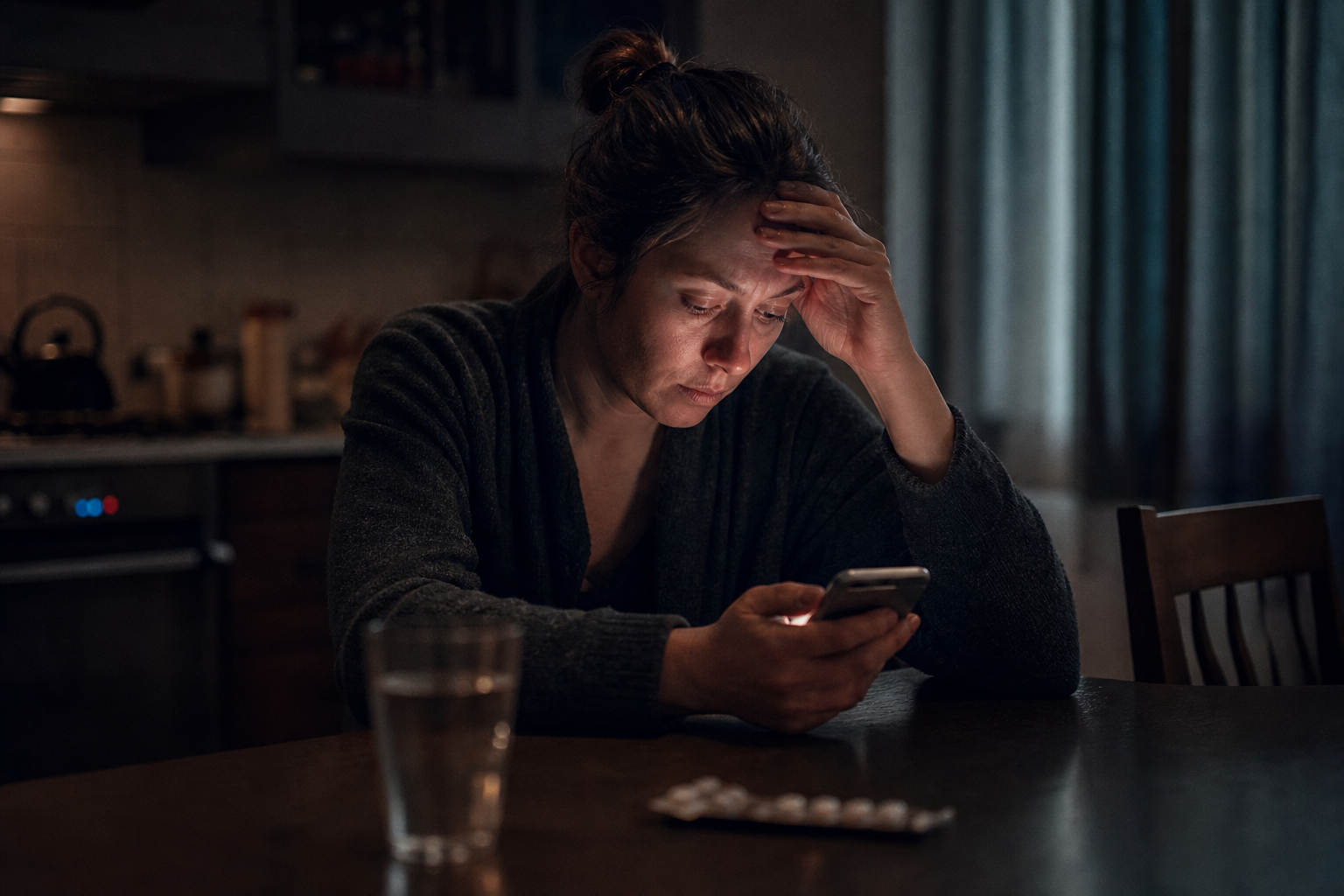
It is 9pm. The worst of the headache has finally loosened its grip, and you are lying in a dark room answering fifty questions about a day you can barely reconstruct.
What did you eat. How many ounces of water. Barometric pressure. Screen time. Stress, one to ten. Neck stiffness, yes or no. By question thirty your thumb is on autopilot and you are guessing, because the brain fog that arrives after an attack does not care that an app wants precision. So you tap something. Anything. And the record you just built is fiction dressed up as data.
This is the part almost no tracker admits: the moment you are least able to log accurately is the exact moment it asks the most of you.
The logging tax
Most tracking apps run on one quiet assumption: more data is better data. Log everything, the thinking goes, and a pattern will surface on its own.
We call the cost of that assumption the logging tax. Every field you agree to fill is a small debt you repay on your worst days, when the after-effects are still sitting on you and self-report is at its least reliable. Pay it long enough and one of two things happens. You quit the app entirely. Or worse, you keep going and quietly stop trusting your own entries, which means the whole record becomes noise you cannot use in front of a doctor.
The way out is not a slicker interface. It is deciding, on purpose, what deserves a slot and cutting the rest loose.
Why tracking everything finds nothing
Volume feels like rigor. It usually produces the opposite. When you log dozens of variables against a handful of attacks, coincidences pile up faster than causes, and you end up 'discovering' triggers that were never triggers at all.
The classic trap is the food you crave right before an attack. You reach for chocolate, or a salty snack, the migraine follows, and the tracker faithfully records a correlation. But that craving is frequently part of the premonitory phase, the earliest hours of the attack itself. The migraine did not follow the chocolate. The chocolate followed the migraine, which had already begun somewhere you could not feel it yet.
Eliminate a food that was never the cause and you get nothing except a smaller diet and a false sense of having solved something.
The craving that looks like a trigger
Foods most often blamed for attacks, especially chocolate, tend to show up in provocation studies as premonitory cravings rather than causes. Chocolate cravings are likely a prodromal symptom of migraine onset rather than a dietary trigger, with double-blind provocative trials failing to confirm chocolate as a trigger. ([source](https://www.facebook.com/headacheaustralia/posts/happy-easter-while-chocolate-is-often-cited-as-a-migraine-trigger-there-is-no-cl/989962676604420/)) Before you cut a food for good, ask whether the urge to eat it was the attack announcing itself.
Five things you can stop logging tonight
None of these are useless in principle. They are just low-yield for most people, high-friction to capture, and rarely the thing that changes what a clinician does next. Unless one of them is your confirmed personal pattern, let it go.
Every meal and snack. Water down to the ounce. Sleep duration measured four different ways. Hourly pain scores. The weather. The table below is the trade: what to drop on the left, what earns the slot instead on the right.
Stop logging in detail
Track this instead
Why it matters more
Every meal and snack
Only your confirmed personal triggers
Food is over-blamed; cravings are often the attack starting
Water intake to the ounce
Dehydrated that day, yes or no
Only useful if dehydration is actually your pattern
Sleep duration, four ways
Whether your sleep schedule stayed regular
Irregular timing tends to drive attacks more than total hours
Hourly pain scores
Time from dose to meaningful relief
Tells your neurologist if the drug and dose are working
Barometric pressure
Functional impact: could you work or drive
You can act on function. You cannot act on the weather
Lower-yield, high-friction data on the left; the lower-effort signal that replaces it on the right.
Five signals actually worth keeping
Here is what survives the cut. Each one is a single answer, not a form, and each one is something you or your doctor can act on.
The recovery window. Not just when the headache stopped, but when you felt like yourself again. For many people the fatigue, residual photophobia, and fog run a full day or two past the pain. That gap is the most under-recorded part of the whole attack.
Time to relief after medication. Did the triptan or gepant work, and how fast? This is the single data point most likely to change a prescription.
Cycle timing, if you menstruate. Perimenstrual attacks are one of the best-established patterns in migraine, and they are actionable in a way weather never will be.
Sleep regularity, as one question. Did you keep roughly your usual schedule? Yes or no beats four competing duration numbers.
Functional impact. Could you work, drive, or care for your kids? This is the language disability paperwork and specialists actually use.
Where the after-phase fits
Notice that the first thing on the keep list, the recovery window, is the one almost no tracker asks about. The record usually ends when the pain does, as if the day the headache lifts is the day you are fine. You are not, and you know it.
We built Postdrome around that missing stretch, because the apps the people in our lives tried all stopped at the headache and left the next two foggy days blank. The point was never to add more fields. It was to make the few that matter easy to reach on a day when you cannot see straight, which is why Aura Mode exists and why the timeline keeps running through the after-phase instead of closing out at zero pain. It lives on your device, and the price is once, for good, with nothing metered behind a monthly charge.
Less to log. A record you can hand to a specialist without apologizing for it.
See what the after-phase looks like when you track it. Get Postdrome.
Postdrome tracks the 24 to 72 hours after the pain, the part most apps leave blank, with a logging flow built for days when reading a screen is the hard part. On-device, portable, and priced once for good.