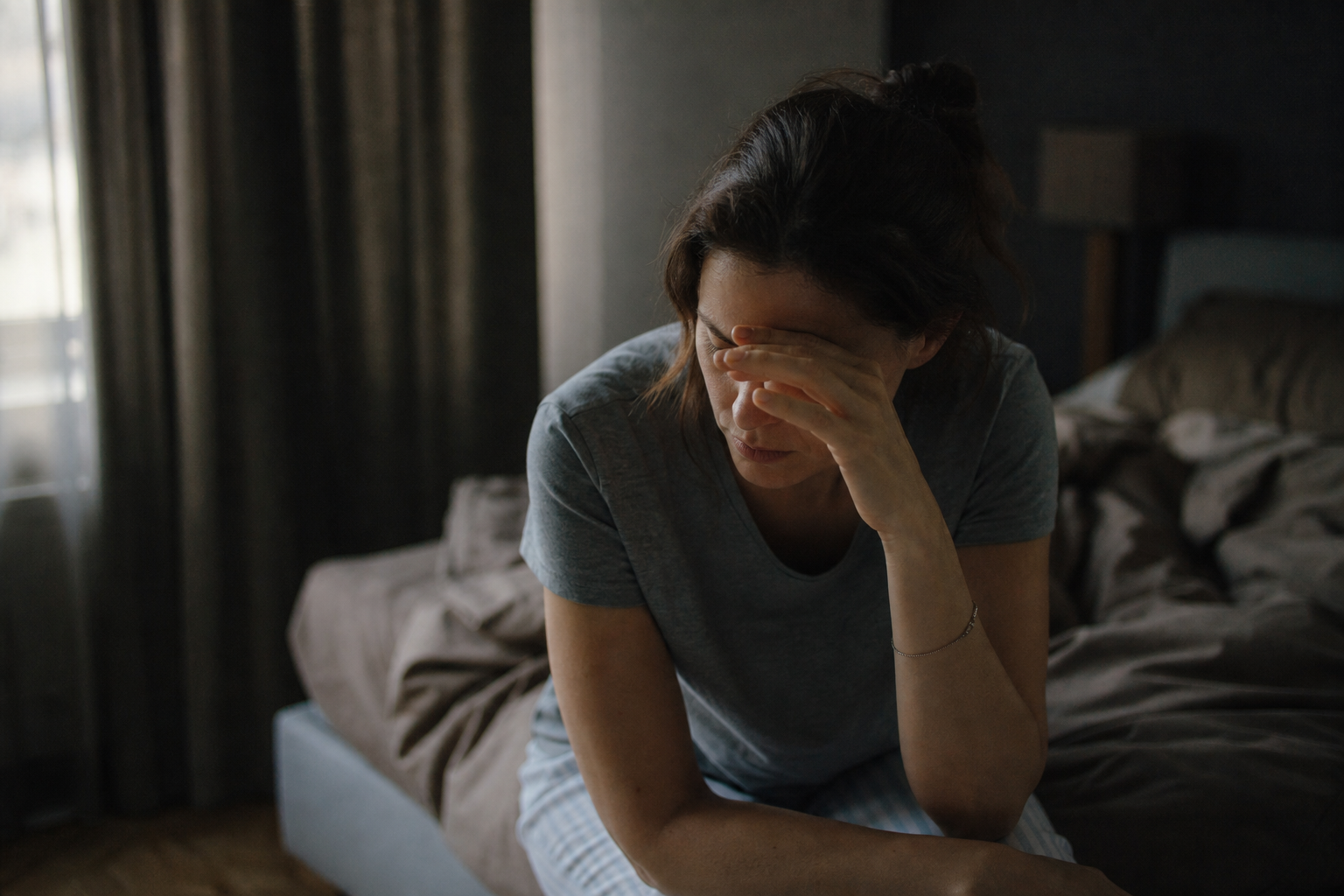
r/migraine's biggest app complaint isn't the headache, it's the days after.
We read what the r/migraine corpus actually says about tracking apps. The pattern: patients log the spike, then get abandoned by every app for the 72 hours that hurt most.
The post that gets rewritten a hundred ways
Scroll r/migraine on any given night and you will find the same post over and over in different words. Someone finished an attack two days ago. The pain is gone. They still can't read a full paragraph, the light over the kitchen sink still stings, and their neck feels like it belongs to someone else. They open the app they downloaded to make sense of all this, and there is nowhere to put any of it. So they close it.
The replies say the same thing back. Mine does that too. None of them have a place for the after part. Read enough of these threads and the surprising fact surfaces fast: they are almost never arguments about how to log the headache better.
The tail talks louder than the spike
Read enough of these threads and a shape emerges we started calling the tail. A migraine app is built around the spike: the hours of pain, the trigger, the medication, the relief. The corpus is built around the tail: the fatigue, the residual photophobia, the brain fog, the mood crash that runs 24 to 72 hours past the point every app has already closed the episode.
The apps capture the condition at its most visible. r/migraine talks about the stretch where it is least visible and most disabling. That mismatch is the whole story.
The event model is the original design mistake
Nearly every tracker on the App Store inherits the same mental model: a migraine has a start time, an end time, an intensity, a trigger, and a treatment. Log those five fields and you have a headache diary. That model came from the paper diaries neurologists handed out decades ago, and it survived the move to phones almost unchanged.
The trouble is that those five fields describe a headache. A migraine is a neurological arc with a prodrome running ahead of it and a postdrome trailing behind. When the design assumes the episode ends when the pain does, the two phases patients most want recognized fall clean outside the form. There is no field for the day you functioned at forty percent because your brain was still rebooting.
What the complaint clusters actually contain
We read the corpus the way you would read a support inbox: not counting keywords, but grouping the recurring asks until the clusters stabilized.
Four clusters carry most of the app-related volume, and only one of them is a request to track the headache better. The largest is the after-phase gap: where do I log fatigue, fog, and lingering light sensitivity once the pain is gone. The second is logging under impairment: people who physically cannot use a bright, text-dense app mid-attack or mid-fog, and abandon the log exactly when it would matter. The third is data portability: months of history that won't come out in a form a neurologist or a new app can read. The fourth is subscription fatigue: paying monthly to see your own health data, then watching it lock when you stop.
Complaint cluster
What the post actually asks for
What most apps ship
After-phase gap
Somewhere to log fog, fatigue, and residual photophobia once the pain stops
A form that closes when the headache ends
Logging under impairment
A way to record while light-sensitive and unable to read
Bright, text-heavy screens that require typing
Data portability
A clean export a neurologist or new app can actually read
Data locked in-app or behind an active subscription
Subscription fatigue
Access to their own history without paying monthly forever
Insights and history gated behind a recurring fee
Many app-related posts touch on postdrome and after-effects, with users describing lingering symptoms that stretch well beyond the acute phase.
of app complaints touch the after-phase, not the attackPostdrome Desk, r/migraine corpus
A recurring frustration across user posts is the difficulty of exporting data and moving it freely between platforms.
raise getting their own data outPostdrome Desk, r/migraine corpus
Subscription and paywall frustration comes up repeatedly across posts, marking it as a consistent theme rather than an isolated complaint.
cite paying monthly to view their own historyPostdrome Desk, r/migraine corpus
One attack, three days, zero data
Follow a single week. Tuesday, an attack hits: aura, four hours of pain, a triptan, relief by evening. That part logs fine. Every app handles it.
Wednesday and Thursday are the postdrome. The drained, foggy, light-sensitive tail where getting through a workday is the entire achievement. There is no screen for that, so nothing gets recorded. Friday the person feels human again and forgets it happened.
Three weeks later they are across from their neurologist, who opens the export and sees a four-hour episode followed by clean days. The record says recovered by Tuesday night. The patient lived it through Thursday. The distance between those two stories is precisely the thing that gets a treatment plan wrong.
The clean-gap problem
Missing postdrome data doesn't just lose detail. It makes every attack look shorter and less disabling than it was. In a chart that feeds a treatment decision, a disability claim, or a work accommodation, an undercounted tail becomes an undercounted burden.
If the tail is the product, the whole design flips
Take the corpus seriously and the design brief inverts. The episode stops being a discrete row with a close button and becomes a continuous timeline that keeps running through recovery. There is a phase after relief, not just before it. Logging has to survive impairment, which means it has to work when the screen is the enemy and typing is out of the question.
And the history belongs to the person who lived it, in a format they can carry to the next neurologist or the next app. None of that is exotic. It is what happens when you build for the days people actually describe, instead of the four hours the old form was shaped around.
What we built after reading the tail
We built Postdrome because we kept reading the same unanswered post. The timeline does not end when the pain does: it carries the after-phase, the fatigue, the residual photophobia, the fog, as its own tracked stretch rather than a footnote. Aura Mode is our answer to logging when you physically can't look at a normal screen, a low-glare, low-text way to mark what's happening without reading a paragraph to do it.
Everything stays on your device, and the price is stated once. Lifetime, not monthly. You are not renting your own symptom history back from us, and it exports in a form a specialist can read. We can't fix your insurer or shorten your postdrome. We can make sure the record finally matches what the week actually felt like.
What we're reading for next
The next corpus pass splits out r/VestibularMigraines, where the after-phase looks different again: the dizziness and visual disturbance don't resolve on the same clock as pain-dominant attacks, and the app complaints skew even harder toward continuous tracking. If the tail is longer and stranger there, the schema has to bend to fit it. That's the read we're running next.
See the timeline that keeps going after the pain stops. Get Postdrome.
Postdrome was built by people who read these threads for months, not by a team guessing at what tracking should feel like. The pricing is stated up front and once: lifetime, on-device, exportable. You are not renting access to your own symptom history.